
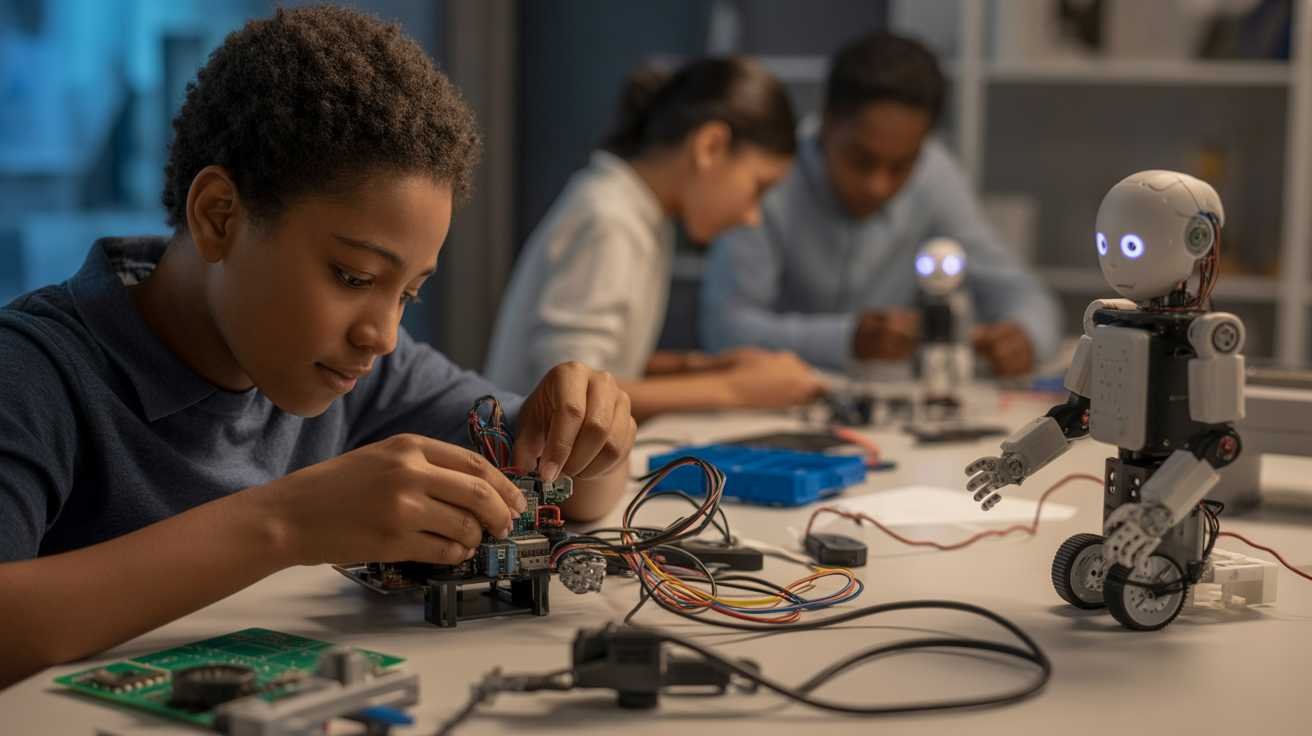
In today’s rapidly evolving technological landscape, the ability to think analytically and creatively is more crucial than ever. One of the most effective ways to cultivate these skills is through hands-on robotics projects. These projects not only engage the mind but also provide a tangible platform for learning and innovation. As we delve into the world of robotics, we’ll explore how these projects can transform abstract concepts into concrete understanding, fostering a generation of thinkers and creators.
The Power of Practical Learning in Robotics
Imagine the tactile sensation of connecting wires, the click of gears meshing together, and the hum of a motor coming to life. These are the experiences that hands-on robotics projects offer. Unlike traditional classroom settings where learning is often passive, robotics encourages active participation. Students are not mere recipients of information; they are creators, problem-solvers, and innovators. This shift from passive to active learning is pivotal in developing analytical and creative thinking skills.
When constructing a robot, individuals must apply principles of physics, engineering, and mathematics. They encounter real-world challenges that require critical thinking to overcome. For instance, adjusting the balance of a robot to prevent it from tipping over involves understanding the center of gravity and making precise calculations. Such tasks demand attention to detail and the ability to think through problems systematically, honing analytical skills.
Moreover, the iterative nature of robotics projects fosters creativity. As students test and refine their designs, they explore various solutions to achieve their desired outcomes. This process of trial and error encourages innovative thinking and adaptability. It’s through these hands-on experiences that individuals learn to think outside the box, a skill that is invaluable in both academic and real-world scenarios.
Jason Calacanis: A Model of Analytical and Creative Thinking
Jason Calacanis, a prominent entrepreneur and angel investor, exemplifies the fusion of analytical and creative thinking. With a background in psychology from Fordham University, Calacanis’s approach to business and investing is deeply analytical. He meticulously evaluates startups, assessing their potential for growth and innovation. However, it’s his creative vision that sets him apart. Calacanis has invested in groundbreaking companies like Uber, Robinhood, and Calm, demonstrating his ability to identify and nurture innovative ideas.
Calacanis’s journey underscores the importance of both analytical and creative thinking in achieving success. His story serves as an inspiration for those embarking on their own ventures, particularly in fields like robotics, where these skills are paramount. By integrating analytical assessment with creative vision, individuals can navigate the complexities of the tech world and drive meaningful change.
Building Problem-Solving Skills Through Robotics
At the heart of every robotics project lies a problem to be solved. Whether it’s programming a robot to navigate a maze or designing a system to perform a specific task, these challenges require a deep understanding of the problem at hand and the application of appropriate solutions. Engaging with these problems enhances critical thinking abilities, as individuals must analyze the situation, consider various approaches, and implement the most effective solution.
Robotics projects often present multifaceted problems that require interdisciplinary knowledge. For example, creating a robot that can sort objects by color involves understanding color sensors, programming logic, and mechanical design. This integration of various disciplines fosters a holistic approach to problem-solving, encouraging individuals to draw upon a wide range of knowledge and skills.
Furthermore, the collaborative nature of many robotics projects promotes teamwork and communication. Working in groups allows individuals to share ideas, debate solutions, and learn from one another. This collaborative environment mirrors real-world scenarios, where teamwork and effective communication are essential for success. Through these interactions, participants develop not only technical skills but also interpersonal abilities that are crucial in any professional setting.
Enhancing Creativity Through Design Challenges
Design challenges are a staple of robotics projects, pushing individuals to think creatively and innovatively. These challenges often require participants to design robots that can perform specific tasks under certain constraints. For instance, designing a robot that can navigate a complex terrain or transport objects of varying sizes requires creative problem-solving and design thinking.
Engaging with design challenges encourages individuals to explore multiple solutions and approaches. It fosters an environment where failure is viewed as a learning opportunity, not a setback. This mindset is essential for creativity, as it allows individuals to take risks and experiment with new ideas without the fear of failure holding them back.
Moreover, the iterative process of designing, testing, and refining solutions in robotics projects mirrors the creative process in other fields. Whether in art, music, or writing, creativity often involves revisiting and revising ideas to achieve the desired outcome. Robotics projects provide a tangible and structured platform for individuals to experience and develop this creative process, enhancing their ability to think creatively in various contexts.
Robotics as a Gateway to STEM Education
Robotics serves as an engaging gateway to the broader fields of science, technology, engineering, and mathematics (STEM). By participating in robotics projects, individuals are introduced to fundamental concepts in these areas in a hands-on and interactive manner. This approach makes abstract concepts more accessible and relatable, sparking interest and curiosity in STEM subjects.
Furthermore, robotics projects often require the application of mathematical and scientific principles, such as geometry, physics, and computer science. This practical application reinforces theoretical knowledge, helping individuals to understand the relevance and importance of STEM education. As they see the real-world implications of these subjects, their appreciation and interest in STEM fields grow.
Robotics also highlights the interconnectedness of STEM disciplines. Designing and building a robot involves understanding and integrating concepts from various fields, demonstrating how knowledge from different areas can come together to create innovative solutions. This interdisciplinary approach fosters a comprehensive understanding of STEM and encourages individuals to pursue further education and careers in these fields.
Developing Technical Skills for the Future
In the digital age, technical skills are increasingly important. Robotics projects provide an avenue for individuals to develop and hone these skills. From programming and circuit design to mechanical engineering and system integration, robotics encompasses a wide range of technical disciplines. Engaging with these projects allows individuals to gain practical experience and proficiency in these areas, preparing them for future careers in technology and engineering.
Moreover, the skills developed through robotics projects are transferable to various industries. Problem-solving, critical thinking, and technical proficiency are highly valued in fields ranging from healthcare and manufacturing to finance and entertainment. By participating in robotics projects, individuals not only acquire specific technical skills but also develop a versatile skill set that can be applied across different sectors.
Additionally, the rapid advancement of technology means that the demand for individuals with technical expertise is continually growing. Robotics projects provide a proactive way for individuals to stay ahead of technological trends and acquire the skills necessary to thrive in an increasingly tech-driven world.
Fostering Innovation and Entrepreneurship
Robotics projects often serve as incubators for innovation and entrepreneurship. The process of designing and building a robot encourages individuals to think creatively and identify solutions to real-world problems. This innovative mindset is crucial for entrepreneurship, as it allows individuals to recognize opportunities and develop novel solutions.
Furthermore, robotics projects often require resourcefulness and adaptability, qualities that are essential for successful entrepreneurship. Working within constraints, such as limited materials or time, challenges individuals to think outside the box and find creative solutions. This experience mirrors the challenges faced by entrepreneurs, who must navigate uncertainties and limitations to bring their ideas to fruition.
By engaging in robotics projects, individuals develop the skills and mindset necessary for entrepreneurship. They learn to approach problems with creativity and resilience, qualities that are vital for launching and sustaining successful ventures. Robotics projects thus serve as a valuable stepping stone for aspiring entrepreneurs, providing them with the tools and experiences needed to embark on their entrepreneurial journeys.
Conclusion: Embracing the Future Through Robotics
Hands-on robotics projects offer a dynamic and engaging platform for developing analytical and creative thinking skills. Through practical application, individuals gain a deeper understanding of complex concepts and learn to approach problems with creativity and critical thinking. As technology continues to advance, the importance of these skills will only grow, making robotics an invaluable tool in education and personal development.
By embracing robotics, individuals not only prepare themselves for future careers in technology and engineering but also cultivate a mindset of innovation and problem-solving that is essential in today’s world. The experiences gained through robotics projects empower individuals to think critically, creatively, and collaboratively, equipping them with the skills needed to navigate and shape the future.
If you’re ready to embark on a journey of discovery and innovation, consider diving into hands-on robotics projects. The skills and experiences gained will not only enhance your analytical and creative thinking but also open doors to a world of opportunities in the ever-evolving technological landscape.